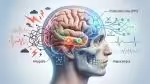
Emotional intelligence is no longer limited to academic debate. Over the past two decades, research from psychology and neuroscience has shown that the ability to understand and manage emotions directly affects communication, stress management, and workplace performance. Studies referenced by the American Psychological Association indicate that emotional regulation and awareness are closely linked to healthier relationships and improved wellbeing.
In practical terms, emotional intelligence shapes everyday reactions, from how someone handles criticism to how they respond during family disagreements. Data from public health and workplace research suggest that emotional skills contribute to reduced conflict, stronger collaboration, and improved mental resilience. As institutions increasingly recognize its measurable value, emotional intelligence has become a central focus in education, healthcare, and leadership development.
Table of Contents
How Researchers Define Emotional Intelligence

Psychologists define emotional intelligence as a set of abilities that enable individuals to recognize, understand, and manage emotions. According to research frameworks published by the American Psychological Association (APA), emotional intelligence includes emotional awareness, regulation, empathy, and interpersonal competence.
These abilities are not abstract traits. They influence measurable behaviors, particularly in environments where communication and teamwork matter. Neuroscience research from the National Institute of Mental Health (NIMH) shows that emotional regulation engages brain regions involved in decision-making and impulse control.
| Core Skill | What It Means | Daily Example |
|---|---|---|
| Self-awareness | Recognizing personal emotions | Identifying frustration before reacting |
| Self-regulation | Managing impulses and reactions | Pausing during conflict |
| Empathy | Understanding others’ feelings | Noticing stress in a colleague’s voice |
| Social skills | Navigating relationships effectively | Resolving misunderstandings calmly |
These skills interact continuously. Awareness without regulation may fail to improve behavior, and empathy without communication skills may fail to reduce conflict.
Emotional Intelligence in Daily Conversations

Communication research shows that misunderstandings often stem from emotional misinterpretation rather than factual disagreement. Tone of voice, facial expressions, and body language carry emotional signals that influence outcomes.
Workplace behavioral studies cited by the U.S. Department of Labor emphasize that employees with stronger interpersonal skills tend to contribute to higher team performance and lower workplace tension. In daily life, this translates into active listening, measured responses, and thoughtful feedback.
For example, instead of responding defensively to criticism, a person with higher emotional intelligence may first seek clarification. Instead of escalating an argument, they may acknowledge the other person’s perspective. These small shifts significantly alter outcomes.
Managing Stress in High-Pressure Situations

Stress is a common feature of modern life. According to public health information provided by the Centers for Disease Control and Prevention (CDC), unmanaged stress can contribute to physical and mental health complications over time.
Emotional intelligence influences how individuals process stress rather than eliminating stress itself. Emotional regulation enables a pause between feeling and action. This pause often prevents impulsive remarks or decisions made under emotional pressure.
Common emotionally intelligent stress responses include:
- Taking a brief pause before replying during heated discussions
- Identifying whether frustration stems from fatigue or a larger issue
- Choosing constructive communication instead of reactive language
These responses may appear simple, but they reduce the likelihood of escalating conflicts and long-term resentment.
Empathy as a Social Stabilizer
Empathy is widely recognized as a key component of emotional intelligence. It involves accurately identifying and understanding another person’s emotional state. Social psychology research shows that empathetic communication increases trust and reduces interpersonal tension.
Data published through educational research initiatives supported by the U.S. Department of Education suggest that social-emotional learning programs improve classroom cooperation and reduce behavioral issues. In adult environments, empathy strengthens workplace morale and family relationships.
In everyday settings, empathy can be observed when a manager acknowledges workload stress before assigning new tasks, or when a family member validates another’s frustration instead of dismissing it. These behaviors create psychological safety.
Emotional Intelligence and Decision-Making
Contrary to the belief that decisions are purely logical, neuroscience research indicates that emotions play a crucial role in evaluating risks and rewards. Emotional intelligence allows individuals to interpret emotional signals without being controlled by them.
When facing uncertainty, an emotionally aware individual may question whether discomfort stems from evidence or is merely temporary stress. This reflective process improves decision consistency. Research in behavioral science suggests that combining emotional awareness with logical reasoning leads to more sustainable outcomes, particularly in leadership roles.
Workplace Performance and Measurable Impact
Organizations increasingly measure interpersonal competencies alongside technical skills. Studies in organizational psychology indicate that leaders with higher emotional intelligence are more effective in conflict resolution and team motivation.
The following professional behaviors are strongly associated with emotional intelligence:
- Delivering feedback constructively
- Managing disagreements without escalation
- Remaining composed during deadlines
These behaviors directly affect productivity, employee satisfaction, and turnover rates. Companies investing in emotional intelligence training often report improved communication and stronger team cohesion.
Emotional Intelligence and Mental Wellbeing
Emotional awareness also plays a protective role in mental health. According to mental health research highlighted by the National Institute of Mental Health (NIMH), recognizing emotional patterns can encourage early coping strategies.
| Situation | Emotionally Intelligent Reaction | Likely Result |
|---|---|---|
| Receiving criticism | Listening before responding | Reduced defensiveness |
| Feeling overwhelmed | Identifying specific stressors | Clearer problem-solving |
| Observing distress in others | Asking supportive questions | Stronger relationships |
| Making a mistake | Accepting responsibility | Faster resolution |
These patterns show how emotional intelligence shapes outcomes through consistent, small behaviors.
Why Emotional Intelligence Matters in Everyday Life
Emotional intelligence is not about suppressing feelings or avoiding disagreement. It involves recognizing emotions, expressing them responsibly, and understanding their influence on behavior. Research from psychological and public health institutions confirms that emotional regulation, empathy, and social competence are measurable skills with real-world implications.
In daily life, emotional intelligence appears in calm responses during conflict, thoughtful decision-making under pressure, and empathetic communication in personal and professional settings. As research continues to demonstrate its link to well-being and performance, emotional intelligence remains a practical skill set rather than a theoretical concept.
Understanding what emotional intelligence really means in daily life reveals its measurable impact: fewer impulsive reactions, stronger relationships, and more stable environments both at home and at work.