Emotions influence almost every part of daily life, from decision-making and relationships to workplace performance and mental health. Psychologists define emotional regulation as the ability to monitor, understand, and adjust emotional responses to help individuals function effectively. Recently, scientific research has identified several practical techniques that consistently help people manage emotional reactions more constructively.
Research in psychology and neuroscience indicates that emotional regulation transcends mere suppression of feelings. Instead, it involves recognising emotions, understanding their triggers, and applying strategies that help maintain balance. Clinical and behavioral research has widely studied techniques such as cognitive reframing, mindfulness, controlled breathing, and emotional awareness. The American Psychological Association discusses detailed research on emotional regulation mechanisms in its guide on emotion regulation and coping.
Table of Contents
Why Emotional Regulation Matters in Daily Life

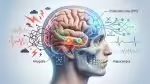
Emotional reactions are driven by interactions between different parts of the brain. The amygdala quickly detects emotional signals such as danger, criticism, or reward, while the prefrontal cortex evaluates situations and helps regulate impulsive responses. According to the National Institute of Mental Health’s explanation of how the brain processes emotions, these brain systems work together to interpret emotional experiences and guide behavior.
When emotional regulation skills are weak, the brain’s threat response can dominate behavior. This may lead to impulsive decisions, anger, anxiety, or prolonged stress. In contrast, strong emotional regulation allows individuals to pause, interpret situations logically, and respond thoughtfully.
Psychological studies have also linked effective emotional regulation to better physical health. Chronic emotional stress has been associated with increased cortisol levels, sleep disruption, and a higher risk of anxiety disorders. Learning practical regulation techniques can therefore help reduce the long-term impact of emotional stress.
Brain’s Role in Managing Emotional Reactions

Neuroscience research has helped scientists understand how emotional regulation works at the biological level. Emotional processing involves several interconnected brain structures that interpret experiences and generate responses.
| Brain Structure | Main Function | Role in Emotional Control |
|---|---|---|
| Amygdala | Detects emotional signals and threats | Triggers rapid emotional responses |
| Prefrontal Cortex | Logical thinking and impulse control | Moderates emotional reactions |
| Hippocampus | Memory formation | Provides context to emotional experiences |
| Anterior Cingulate Cortex | Emotional awareness and conflict monitoring | Helps evaluate emotional responses |
Brain imaging studies discussed by the U.S. National Library of Medicine in research on neural mechanisms of emotion regulation show that emotional regulation strategies often increase activity in the prefrontal cortex while reducing excessive amygdala reactivity.
Cognitive Reframing: Changing How Situations Are Viewed
One of the most widely studied emotional regulation techniques is cognitive reframing, also known as cognitive reappraisal. This method involves deliberately changing how a situation is interpreted to alter its emotional impact.

For example, receiving critical feedback at work may initially trigger embarrassment or frustration. However, reframing the event as an opportunity for professional improvement can reduce negative emotional intensity and encourage problem-solving. Cognitive reappraisal is a central technique used in therapy programs such as cognitive-behavioural therapy, as explained in the National Health Service’s guide on cognitive behavioural therapy.
Psychological research shows that individuals who regularly practice cognitive reframing report lower levels of stress and anxiety. By shifting interpretation rather than suppressing feelings, this technique strengthens the brain’s ability to regulate emotional responses.
Mindfulness and Present-Moment Awareness
Mindfulness has become one of the most widely researched approaches to emotional regulation in modern psychology. It focuses on paying attention to present experiences while maintaining a non-judgmental awareness of thoughts and emotions.
Rather than trying to suppress feelings, mindfulness encourages individuals to observe emotions as temporary mental events. This helps reduce emotional reactivity and improves awareness of emotional triggers.
Clinical programs such as Mindfulness-Based Stress Reduction have demonstrated measurable improvements in emotional control and stress management. Research summarized by the National Center for Complementary and Integrative Health on mindfulness meditation explains how mindfulness practices influence attention, emotional awareness, and psychological well-being.
Breathing Techniques That Calm Emotional Responses
Strong emotions often trigger physical reactions, such as rapid breathing, muscle tension, or an increased heart rate. Controlled breathing techniques can directly influence the body’s stress response and help restore calm.
Slow breathing activates the parasympathetic nervous system, which counteracts the body’s “fight-or-flight” response. Because of this effect, breathing exercises are widely recommended in stress-management programs and therapeutic interventions.
Common breathing practices recommended by psychologists include:
- Diaphragmatic breathing, which focuses on slow and deep breaths from the abdomen
- Box breathing, where inhaling, holding, exhaling, and pausing occur for equal counts
- 4-7-8 breathing, a rhythm that slows breathing and promotes relaxation
- Paced breathing, maintaining a steady, slow breathing rhythm for several minutes
Even a few minutes of controlled breathing can noticeably reduce emotional intensity during stressful situations.
Recognising and Naming Emotions Clearly
Another important step in emotional regulation is accurately identifying emotions. Many people describe their feelings using general terms such as “stress” or “overwhelmed,” even though these states often involve several distinct emotional experiences.
Psychological studies have shown that labeling emotions precisely can reduce their intensity. This process, sometimes called affect labeling, activates brain regions involved in cognitive control and emotional evaluation.
Developing emotional awareness generally involves several simple steps:
- noticing physical signals such as tension, fatigue, or rapid breathing
- identifying the specific emotion involved, such as frustration, disappointment, or anxiety
- examining the event that triggered the reaction
- observing how the emotion changes over time
By clearly identifying emotions, individuals gain greater control over how they respond.
Everyday Habits That Support Emotional Balance
Emotional regulation, the ability to manage and respond to emotional experiences, is not limited to mental techniques. Daily habits also influence how effectively people manage emotional responses. Research in behavioral science shows that lifestyle factors such as exercise, sleep quality, and social interaction significantly affect emotional stability.
| Habit | Description | Emotional Benefit |
|---|---|---|
| Regular Physical Activity | Activities such as walking, cycling, or strength training | Improves mood and reduces stress hormones |
| Consistent Sleep Schedule | Maintaining regular sleep patterns | Enhances emotional control and decision-making |
| Social Interaction | Talking with trusted friends or family members | Supports emotional processing |
| Structured Routine | Maintaining predictable daily schedules | Reduces uncertainty and stress |
Combining these habits with cognitive and mindfulness techniques establishes a stable foundation for long-term emotional resilience.
Building Healthier Emotional Responses
Decades of psychological research support the use of techniques such as cognitive reframing, mindfulness, controlled breathing, and emotional awareness for emotional regulation. These strategies help individuals manage emotional reactions more effectively while reducing stress and improving overall well-being.
Modern psychology increasingly emphasizes emotional regulation as a practical life skill. By understanding how emotions arise and applying scientifically supported techniques, individuals can develop greater resilience and respond to challenges with clearer thinking and emotional balance.