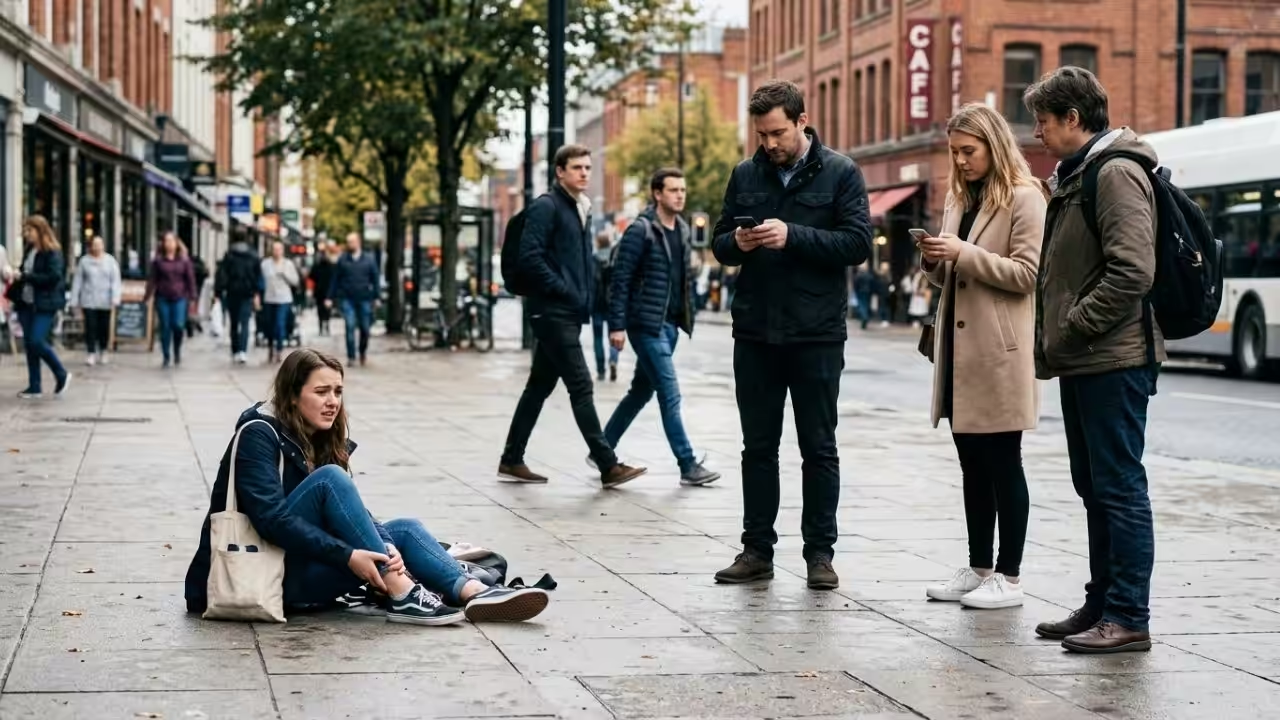
The bystander effect is a well-documented psychological phenomenon in which individuals are less likely to help a person in need when other people are present. Researchers in social psychology have studied this behavior for more than five decades, and the results consistently show that the presence of a group can reduce personal responsibility. This effect has been observed in public places, schools, workplaces, and online platforms, making it an important topic in understanding everyday human behavior.
Scientific research shows that people do not ignore emergencies because they lack concern. Instead, hesitation often happens because individuals assume someone else will act first. Studies by social psychologists have confirmed that response time slows when more witnesses are present. Understanding this behavior helps explain why help may not arrive quickly, even when many people are nearby.
Table of Contents
How Psychologists First Identified the Bystander Effect

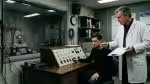
Interest in the bystander effect increased in the 1960s when psychologists began testing how people react during emergencies. Early experiments by social psychologists demonstrated that individuals were more likely to help when they believed they were the only witness. When participants thought others were also present, the number of people who responded quickly decreased.
Later studies confirmed similar patterns in different countries and social settings. These results showed that the bystander effect is not limited to one culture but is a general human behavior linked to group psychology.
Psychological Factors That Cause the Effect
Researchers have identified several mental processes that explain why people hesitate to help when others are present. These factors interact to influence how individuals interpret a situation.
| Factor | Explanation | Result |
|---|---|---|
| Diffusion of responsibility | Responsibility feels shared among all observers | Less personal action |
| Social influence | People watch others to decide what to do | Delayed response |
| Fear of embarrassment | Concern about reacting incorrectly | Hesitation |
| Uncertainty | Situation not clearly dangerous | Inaction |
| Evaluation anxiety | Fear of being judged | Avoidance |
Diffusion of responsibility is considered the strongest factor. When many people are present, each individual feels less pressure to act. Social influence also plays a major role because people often wait to see how others react before deciding what to do.
Common Everyday Situations Where It Happens
The bystander effect does not occur only in serious emergencies. It can appear in many ordinary situations where someone needs help, but others are present. In these cases, responsibility becomes unclear, and action may be delayed.
- A person falls in a crowded street while people watch without helping
- A student is bullied while classmates stay silent
- Someone asks for help in a public transport station but receives no response
- A worker faces harassment while colleagues avoid involvement
- Harmful posts online remain unreported because users expect others to report them
These situations show that the bystander effect can happen in both real-life and digital environments. The common factor is the presence of multiple observers, which reduces the feeling of personal responsibility.
When People Are More Likely to Help

Studies show that certain conditions make people more willing to act. When responsibility is clear, the chance of intervention increases.
| Situation | Likelihood of Helping | Reason |
|---|---|---|
| Alone with victim | High | Responsibility is clear |
| Small group present | Moderate | Responsibility partly shared |
| Large crowd present | Low | Diffusion of responsibility |
| Emergency obvious | High | No confusion |
| Situation unclear | Low | People hesitate |
| Victim known | High | Personal connection |
When individuals know that no one else will help, they are more likely to respond immediately. In large crowds, people often assume that someone else will take responsibility.
The Role of Culture, Society, and Social Pressure
Social and cultural expectations can influence the strength of the bystander effect. In some communities, people are encouraged to help strangers, while in others, individuals may be taught to avoid involvement in unfamiliar situations.
Studies also show that people are more likely to help someone they know or someone they feel connected to. Shared identity, friendship, or group membership increases the chance of intervention. When the victim is unknown, hesitation becomes more common.
These programs often teach people to recognize situations that need help and to act safely.
How Awareness Training Can Reduce the Bystander Effect
Psychologists have found that awareness of the bystander effect can make people more likely to help. When individuals understand that others may also hesitate, they feel a stronger sense of personal responsibility.
Many schools, workplaces, and safety organizations use training programs that encourage direct action.
- Recognize when a situation requires help
- Take responsibility instead of waiting for others
- Give clear instructions to a specific person
- Call emergency services without delay
- Support victims even in non-emergency situations
Programs based on these methods are used in universities and public safety training across many countries. Research shows that people who receive such training respond more quickly during real situations.
The Bystander Effect in the Digital World
Modern research shows that the bystander effect also exists online. When harmful content appears on social media, thousands of people may see it, but each person assumes someone else will report it. This delay can allow harassment or misinformation to continue.
Digital behavior studies published by the National Science Foundation – Social and Behavioral Research suggest that smaller groups are more likely to take action than large audiences. When fewer people are present, responsibility feels more personal.
Online platforms now aim to reduce the bystander effect by making reporting tools easier to use and encouraging users to act individually rather than rely on others.
Why Understanding the Bystander Effect Matters
The bystander effect explains why people sometimes fail to help even when many witnesses are present. Scientific research shows that hesitation is usually caused by diffusion of responsibility, social influence, and fear of making mistakes, rather than by a lack of concern. These factors can affect behavior in public places, workplaces, schools, and online environments.
Understanding this phenomenon is important for everyday life because awareness can reduce hesitation. Training programs, education, and clear responsibility can encourage people to act more quickly when someone needs help. When individuals recognize that everyone may be waiting for someone else, they are more likely to step forward themselves, thereby making communities safer and more responsive.