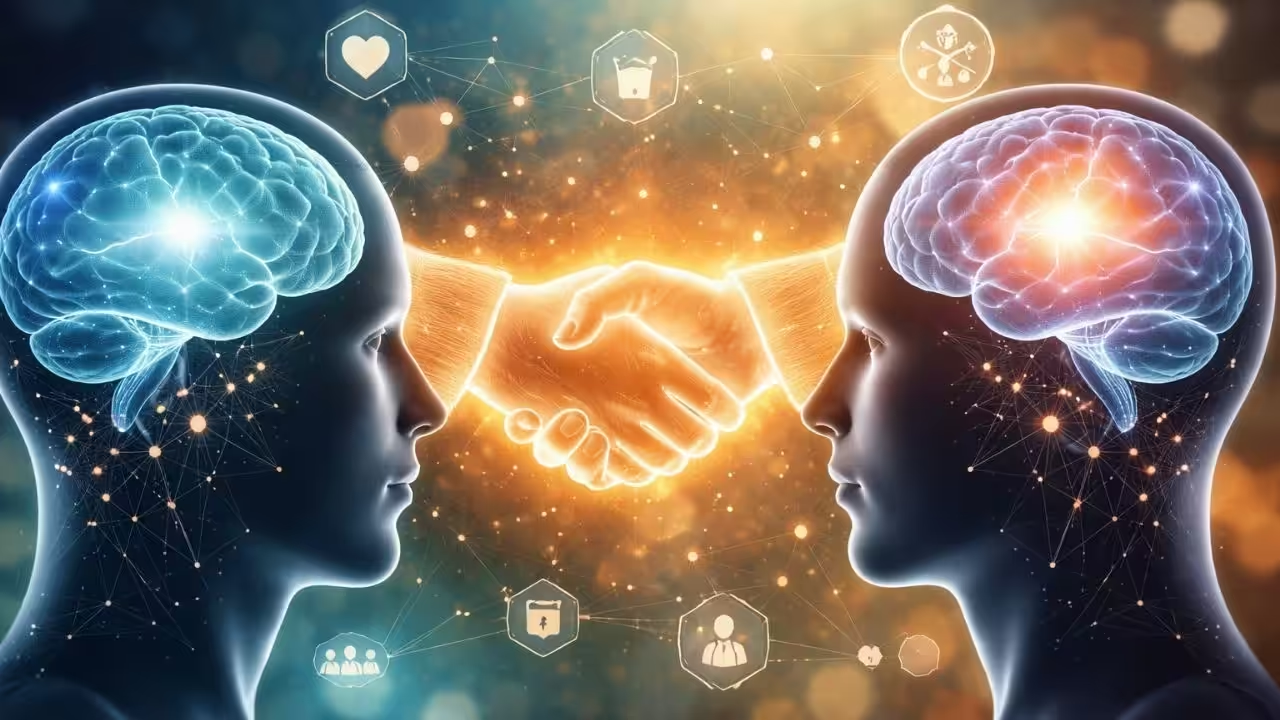
Trust plays a critical role in human relationships, institutions, and social systems. Whether in personal friendships, workplaces, or governments, trust allows people to cooperate without constant monitoring or fear of betrayal. Researchers in psychology, neuroscience, and economics have spent decades studying how trust forms and why it sometimes breaks.
Scientific evidence indicates that trust transcends mere emotional response. It is a complex process influenced by brain chemistry, past experiences, and social behavior. Studies published through the PubMed Central research archive explain that trust affects decision-making, cooperation, and long-term relationships across societies.
Table of Contents
How Researchers Define Trust

In behavioral science, trust refers to the willingness to rely on another person or institution while accepting a certain level of vulnerability. This definition highlights an important aspect of trust-risk. When individuals trust someone, they acknowledge the potential for unfulfilled expectations.
Researchers frequently study trust using behavioral experiments known as trust games. In these experiments, participants decide whether to share resources with others, even when selfish behavior might provide immediate benefits. Results consistently show that many people choose cooperation. The National Institutes of Health research database documents detailed findings about these experiments and their psychological implications.
These experiments suggest that humans are naturally inclined toward social cooperation when they believe others will act fairly.
Brain Chemistry That Influences Trust

Neuroscience research has identified several biological factors that influence trust decisions. One of the most widely studied chemicals linked to trust is oxytocin, a hormone associated with social bonding and cooperation.
Research supported by the National Institute of Mental Health shows that oxytocin levels increase during positive interactions, such as cooperation, empathy, and supportive communication. Higher oxytocin levels can strengthen feelings of connection and increase the likelihood of trusting behavior.
At the same time, the brain constantly evaluates risk. The amygdala detects potential threats and warns individuals when behavior appears suspicious. Meanwhile, the prefrontal cortex processes reasoning, reputation, and long-term consequences. These brain systems work together to determine whether trust should be extended or withheld.
Major Brain Regions Involved in Trust
| Brain Region | Primary Role | Influence on Trust |
|---|---|---|
| Amygdala | Detects threats | Creates caution when behavior seems risky |
| Prefrontal Cortex | Decision making | Evaluates reputation and long-term outcomes |
| Striatum | Reward processing | Reinforces cooperation and social bonding |
| Hypothalamus | Hormone regulation | Helps release oxytocin during social interaction |

These biological mechanisms demonstrate that trust involves both emotional responses and rational evaluation.
Behavioral Signals That Build Trust
Trust rarely appears instantly. Instead, it develops gradually as people observe patterns of behavior over time. When individuals consistently act in reliable and transparent ways, others begin to feel confident about future interactions.
Organizational psychology research shows that leaders who communicate openly and act consistently tend to earn greater trust from employees. Similar patterns occur in personal relationships when individuals demonstrate honesty, reliability, and empathy.
Several behaviors are commonly associated with trust formation:
- Consistency between promises and actions
- Transparent communication about intentions and decisions
- Competence in completing responsibilities
- Fair treatment of others within a group
- Empathy and respect during interactions
When these behaviors appear repeatedly, individuals begin to predict future actions with greater confidence. Predictability reduces uncertainty, making cooperation easier.
Why Trust Strengthens Economies and Communities
Trust is not only important for relationships it also affects entire economies. Economists describe trust as a form of social capital, meaning the collective value created by reliable and cooperative relationships.
Research by the Organisation for Economic Co-operation and Development (OECD) shows that societies with higher levels of trust tend to experience stronger economic stability, higher civic participation, and more efficient institutions.
Areas Where Trust Creates Social Benefits
| Sector | Impact of Strong Trust |
|---|---|
| Business | Faster cooperation and reduced monitoring costs |
| Government | Higher public confidence and civic participation |
| Healthcare | Better communication between patients and professionals |
| Communities | Greater cooperation and reduced conflict |
These findings highlight how trust supports both economic development and social stability.
Why Trust Breaks So Easily
Although trust takes time to build, it can collapse quickly when expectations are violated. Psychological studies show that negative experiences tend to have a stronger emotional impact than positive ones.
When people perceive dishonesty or unfair treatment, the brain’s threat detection system becomes more active. This response encourages caution and can lead individuals to reassess previous interactions.
Several factors commonly contribute to broken trust:
- Misleading information or deception
- Failure to keep promises or agreements
- Unfair use of authority or power
- Avoiding responsibility after mistakes
Once trust is damaged, individuals often become more skeptical and protective in future interactions.
Rebuilding Trust After it Breaks
Although repairing trust can be difficult, research suggests it is sometimes possible through consistent behavioral change. Studies in conflict resolution indicate that rebuilding trust requires transparency, accountability, and repeated evidence of improvement.
Individuals or organizations attempting to restore trust typically need to acknowledge the violation, explain corrective actions, and demonstrate reliable behavior over time. Simple apologies rarely work unless they are followed by visible changes.
Why Trust Remains Essential
Trust remains one of the most powerful forces shaping human cooperation. It allows people to share information, collaborate in organizations, and participate in economic systems without constant oversight.
Scientific research shows that trust develops through biological processes in the brain, reinforced by social experiences and institutional transparency. As societies become increasingly connected through technology and global networks, maintaining trust between individuals and institutions will remain essential for long-term stability and cooperation.