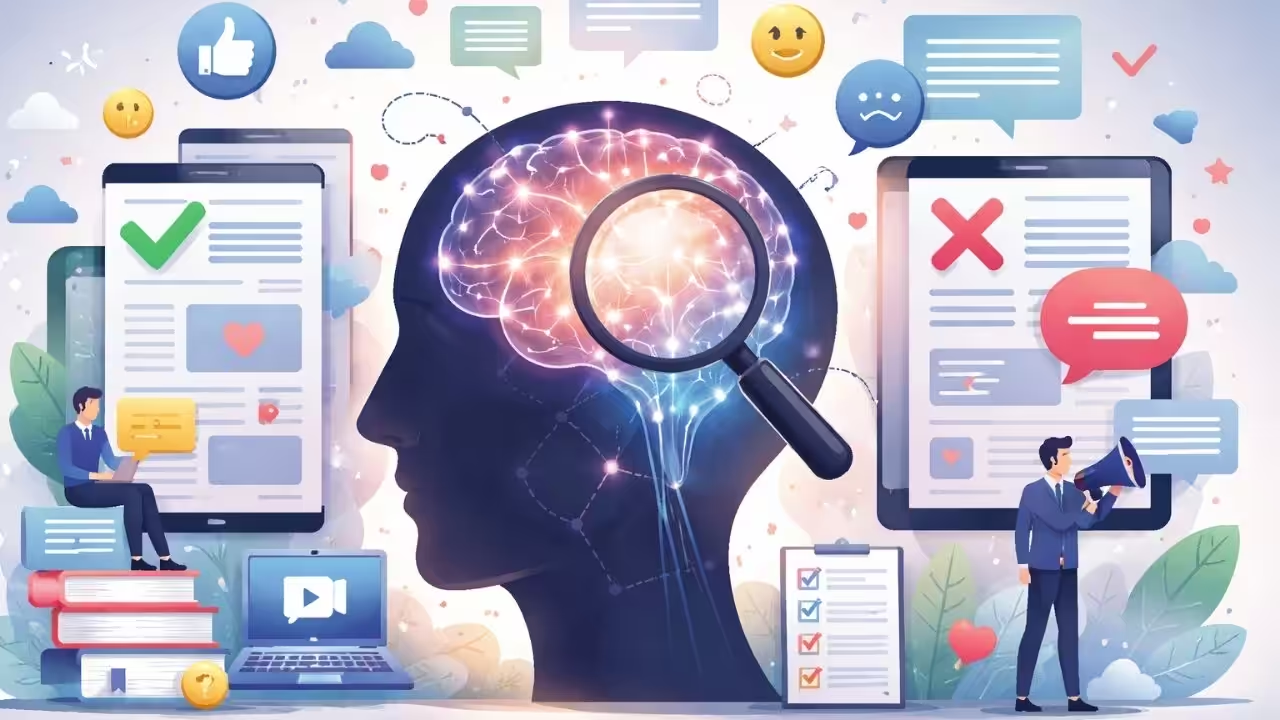
Human beings often believe they evaluate information logically, but psychological research suggests that the brain frequently favors information that supports existing views. This tendency, known as confirmation bias, influences how people interpret evidence, read news, and form opinions about social or political issues.
Scientists studying cognitive behavior say confirmation bias can shape everyday decisions without individuals realizing it. From health choices to financial planning and online discussions, people may unconsciously select information that confirms what they already believe while overlooking opposing evidence.
Table of Contents
Understanding Confirmation Bias in Human Thinking

Confirmation bias is a cognitive pattern in which individuals search for or interpret information in ways that support pre-existing beliefs. Researchers have studied this behavior for decades within cognitive psychology and behavioral science.
According to research resources from the American Psychological Association, bias occurs when people give more weight to evidence that confirms their views while discounting contradictory information. This process can change how people think, make decisions, and understand news or scientific discoveries.
In real life, confirmation bias often means people are more likely to read articles, studies, or opinions that align with what they already believe. When conflicting information appears, it may be dismissed or interpreted differently, often leading individuals to reinforce their existing beliefs rather than reconsider their viewpoints.
How Psychological Research Identified the Bias
The concept gained attention in the 1960s through experimental studies on reasoning and hypothesis testing. One of the most widely cited experiments involved participants identifying number patterns. Instead of testing ideas that might disprove their assumptions, many participants searched only for confirming examples.
Researchers later expanded this work to areas such as politics, healthcare, and media consumption. Modern behavioral studies continue to show that confirmation bias is a widespread cognitive tendency across cultures and educational levels.
For further scientific background, readers can explore research summaries on the National Institute of Mental Health website, which explain how cognitive processes influence perception, belief formation, and decision-making.
Where Confirmation Bias Appears in Everyday Life

Confirmation bias is not limited to academic research. It frequently appears in daily situations in which people interpret information through personal experiences or expectations.
Examples include how individuals follow news stories, interpret health advice, or evaluate investment decisions. Online environments have intensified this effect because digital platforms often recommend content based on past behavior.
| Area of Daily Life | Example of Confirmation Bias |
|---|---|
| News Consumption | People follow news sources that match their political views |
| Health Decisions | Individuals seek medical advice supporting preferred treatments |
| Financial Planning | Investors favor positive forecasts about chosen assets |
| Social Media | Users engage more with posts aligning with personal beliefs |
| Personal Relationships | Individuals interpret behavior according to prior assumptions |
The Brain’s Role in Reinforcing Beliefs
Neuroscience research shows that the brain naturally prefers cognitive consistency. Accepting information that fits existing beliefs requires less mental effort than reconsidering those beliefs.
Psychologists explain that confirmation bias may also reduce emotional discomfort. When people encounter information that challenges strongly held views, it can create psychological tension known as cognitive dissonance. Ignoring or reinterpreting the information helps maintain mental stability.
Memory processes can also strengthen confirmation bias. People tend to remember events or information that confirms their beliefs more easily than contradictory evidence. Over time, these selective memories reinforce personal opinions.
Social Media and the Rise of Information Echo Chambers
Digital technology has amplified the influence of confirmation bias. Recommendation algorithms used by major online platforms analyze user behavior and display content similar to what users previously viewed or liked.
As a result, individuals may repeatedly encounter opinions that reinforce their beliefs while mostly missing opposing viewpoints. Researchers often characterize this environment as an “information echo chamber,” where a limited circle of perspectives repeatedly reinforces ideas.
Several factors contribute to this phenomenon:
- Personalized content recommendations based on user activity
- Online communities centered around shared viewpoints
- Rapid sharing of opinion-driven posts rather than verified data
- Reduced exposure to diverse information sources
Evidence From Behavioral and Cognitive Studies
Scientific research has repeatedly confirmed that confirmation bias influences reasoning across different fields. Studies examining political discussions, legal decisions, and scientific analysis all reveal similar patterns.
| Field of Study | Observed Behavior | Potential Impact |
|---|---|---|
| Political Psychology | Individuals interpret evidence to support ideological views | Increased polarization |
| Medical Decision-Making | Patients prefer information validating treatment choices | Health decision risks |
| Scientific Research | Researchers may initially favor expected outcomes | Importance of peer review |
| Criminal Investigations | Investigators interpret evidence supporting initial theories | Possible investigative errors |
These findings highlight why many professional fields rely on structured review systems, such as peer review in science or multiple-judge panels in legal cases.
Steps Experts Suggest to Reduce Confirmation Bias
Although confirmation bias is a natural cognitive tendency, psychologists say certain practices can help reduce its influence. Developing critical thinking habits and actively examining alternative viewpoints are among the most effective approaches.
Experts often recommend the following methods:
- Reviewing evidence from multiple independent sources
- Seeking information that challenges personal assumptions
- Engaging in discussions with individuals holding different perspectives
- Using structured decision-making processes when analyzing data
These strategies encourage balanced information processing and reduce the likelihood of relying only on confirming evidence, which is crucial for making informed decisions and fostering constructive dialogue in diverse discussions.
Why Recognizing Confirmation Bias Matters
Understanding confirmation bias has become increasingly important in a world where information travels quickly and opinions spread widely online. When individuals recognize how this cognitive tendency works, they may become more careful in evaluating the evidence behind their beliefs.
Researchers emphasize that awareness of confirmation bias does not eliminate it entirely. However, recognizing its influence encourages more thoughtful decision-making and helps people remain open to new information.
As psychological science continues to explore how the brain processes evidence and belief systems, confirmation bias remains a central concept in understanding human judgment. By approaching information with curiosity and critical thinking, individuals can make more informed choices and contribute to more balanced public discussions.