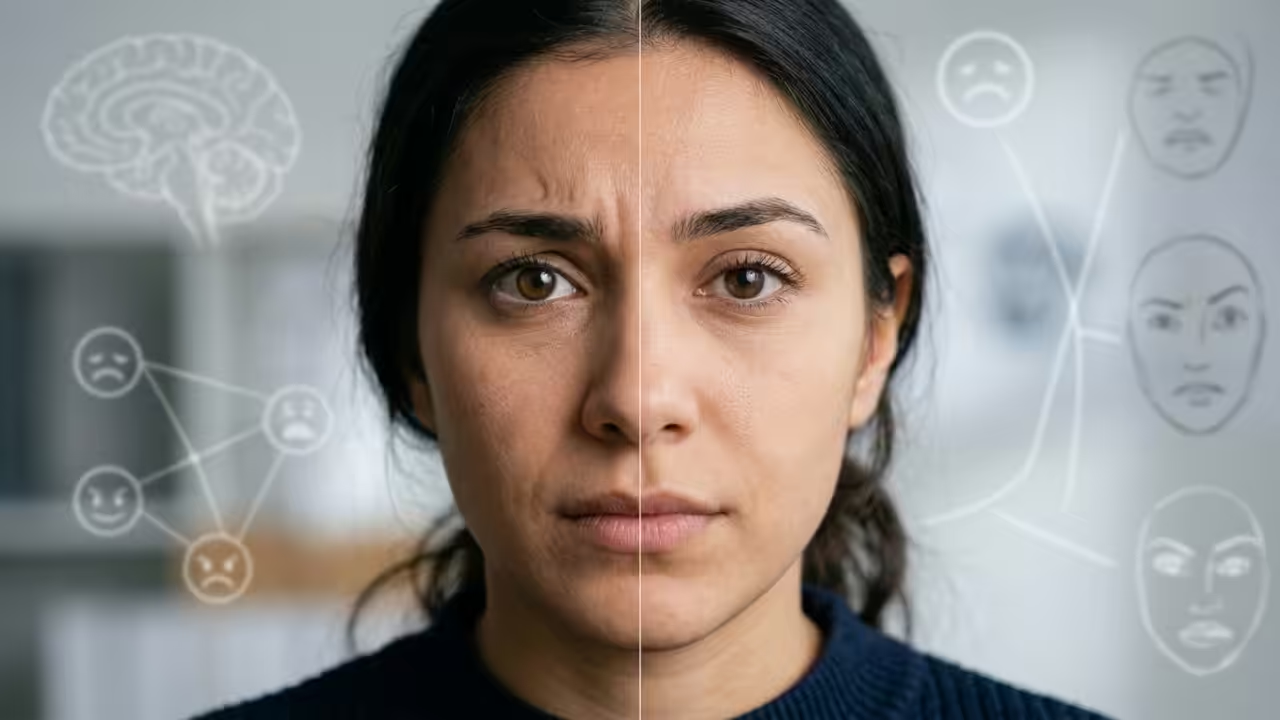
Human emotions are often communicated through words, gestures, and tone of voice. However, psychologists have long observed that facial expressions can reveal feelings that people may attempt to hide. One of the most intriguing aspects of facial behavior is the presence of microexpressions, very brief, involuntary facial movements that reveal genuine emotional reactions.
Micro-expressions usually appear for a fraction of a second before a person consciously controls their face. Because these expressions occur automatically, they can provide valuable clues about emotions such as fear, anger, surprise, or happiness. Researchers studying human behavior have found that understanding these subtle signals helps explain how people communicate emotions beyond spoken language.
Table of Contents
What Exactly Are Micro-Expressions?

Microexpressions are extremely rapid facial expressions that occur when an individual experiences an emotion while trying to conceal it. These expressions often last between 1/25 and 1/5 of a second, making them difficult to detect during normal conversations.
Psychologists studying emotional expression discovered that automatic neurological responses, rather than deliberate behavior, control many facial reactions. The brain processes emotional stimuli quickly, sometimes triggering facial muscle movements before conscious control can intervene.
The scientific study of facial expressions has been widely documented by behavioral researchers and institutions such as the National Institute of Mental Health, which examines emotional processing and human behavior.
Scientific Research Behind Facial Emotion Detection

Understanding micro-expressions became easier after the development of the Facial Action Coding System (FACS). This system categorizes facial movements based on the activation of specific muscles, enabling researchers to objectively analyze emotional signals.
The human face contains more than 40 muscles capable of producing thousands of facial combinations. These muscles respond to emotional signals generated in the brain, particularly in regions involved in emotional processing, such as the amygdala.
| Research Element | Details |
|---|---|
| Facial muscles involved | More than 40 facial muscles contribute to emotional expressions |
| Typical duration of micro-expressions | Between 0.04 and 0.20 seconds |
| Research method | Facial Action Coding System (FACS) |
| Brain region linked to emotion | Amygdala and limbic system |
| Observation techniques | High-speed cameras and frame analysis |
Common Emotions Revealed Through Micro-Expressions

Psychological research has identified several basic emotions that appear consistently across cultures. These emotions produce similar facial expressions across languages and geographic locations.
Even when individuals attempt to hide their reactions, brief facial signals may reveal their true feelings. The following table highlights common emotions and their typical micro-expression features.
| Emotion | Facial Indicators |
|---|---|
| Happiness | Raised cheeks and wrinkles near the eyes |
| Sadness | Drooping eyelids and downward lips |
| Anger | Tightened lips and lowered eyebrows |
| Fear | Wide eyes and raised eyebrows |
| Surprise | Open mouth and lifted eyebrows |
| Disgust | Wrinkled nose and raised upper lip |
| Contempt | Slight one-sided mouth movement |
These signals appear rapidly and are often replaced by controlled facial expressions immediately afterward.
Why People Try to Hide Their Emotions
In many situations, individuals attempt to regulate how they display emotions. Social expectations, workplace norms, and interpersonal relationships often influence how people present themselves.
For instance, employees may hide their frustration during meetings, public speakers may suppress nervousness, and individuals may mask their disappointment in social settings. Despite these efforts, the brain’s automatic emotional responses can trigger brief facial expressions before conscious control takes effect.
Several factors influence emotional concealment in everyday interactions:
- Social norms that encourage emotional restraint in public settings
- Professional environments where confidence and composure are expected
- Cultural influences that shape how emotions are displayed
- Personal motivations such as avoiding conflict or protecting privacy
These factors explain why microexpressions often occur when people try to manage their emotional responses.
How Researchers Detect Micro-Expressions
Because micro-expressions occur so quickly, scientists rely on specialized observation techniques to study them. High-speed cameras and slow-motion playback allow researchers to identify subtle facial movements that might otherwise go unnoticed.
Modern behavioral studies also use computer-assisted facial recognition tools that analyze muscle movement patterns. These technologies help researchers measure emotional responses with greater accuracy.
Methods commonly used in micro-expression research include:
- Frame-by-frame analysis of recorded facial reactions
- Facial Action Coding System (FACS) classification of muscle movements
- Experimental observation of emotional reactions to visual or auditory stimuli
- Psychological testing combined with facial behavior monitoring
The scientific understanding of emotions expressed through the face has significantly expanded thanks to these techniques.
Real-World Uses of Micro-Expression Research
Academic psychology originally studied micro-expressions, but their findings are now applicable across several professional fields. Understanding subtle emotional cues can help professionals interpret reactions that may not be expressed verbally.
In psychology and mental health, therapists sometimes observe facial expressions to better understand emotional responses during conversations. In education, teachers may notice brief expressions of confusion or curiosity among students.
Similarly, professionals involved in negotiation, healthcare communication, and behavioral research often benefit from recognizing subtle emotional signals. Experts emphasize that one should never interpret micro-expressions as definitive proof of dishonesty or malice.
Emotional reactions are complex and influenced by context, personality, and cultural background. Therefore, facial expressions must always be considered alongside other behavioral cues.
What Micro-Expressions Reveal About Human Communication
The study of microexpressions highlights how deeply emotions are intertwined with human communication. Even when individuals carefully control their words and gestures, the face may briefly reveal genuine reactions.
These subtle signals illustrate how the brain and facial muscles work together to automatically express emotions. By observing these fleeting expressions, researchers can analyze emotional responses during everyday interactions.
Understanding micro-expressions does not mean reading minds, but it can help individuals become more aware of the emotional dynamics that shape conversations and relationships.
Understanding Emotions Beyond Words
Micro-expressions provide a fascinating glimpse into the hidden layers of human emotion. These rapid and involuntary facial movements reveal how quickly the brain responds to emotional stimuli, often before a person has time to consciously manage their expression.
Scientific research on facial behavior has helped psychologists better understand the relationships among emotions, brain activity, and communication. It is important to be careful and have the right context when interpreting micro-expressions, but these small signals are still a useful way to study how people act.