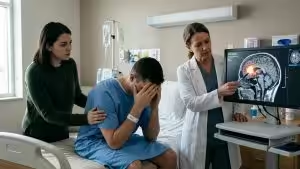
For Tatyana Thompson, pain was a constant presence in her life. It was something that stayed. Diagnosed with sickle cell disease at just two months old, she grew up in a reality where discomfort was not occasional but constant. Her life was shaped around a condition that affected her blood, her energy, and her ability to live freely.
Sickle cell disease is a genetic disorder in which red blood cells lose their normal round shape and become stiff and curved. These abnormal cells struggle to move smoothly through blood vessels, often blocking circulation. This leads to severe pain episodes, reduced oxygen flow, and long-term damage to organs.
For Thompson, these symptoms were not just medical explanations. They were daily experiences. Pain could strike in different parts of her body, including her joints, limbs, and back. Some days, the intensity was so overwhelming that even simple movements became difficult. It was not just physical suffering. It was a life built around managing that suffering.
Table of Contents
When Motherhood Became More Challenging
Her journey took a more emotional turn when she became a mother. Pregnancy and childbirth did not ease her condition. Instead, the pain became even more frequent and intense. This made it harder for her to experience the early stages of motherhood the way she had hoped.
There were moments she missed important milestones that many parents cherish. Her son’s first words and first steps happened during times when she was dealing with severe health complications. These missed experiences left a lasting emotional impact.
Motherhood, which should have been filled with joy and presence, became a mix of love and loss. She wanted to be fully there for her child, but her condition often pulled her away. Over time, these experiences created a strong desire for change. She began looking for a way to break free from the cycle of pain that had defined her life for so long.
Years of Managing an Unrelenting Condition
Before her breakthrough treatment, her daily routine revolved around pain management. She depended on regular medication to get through the day. This included strong painkillers taken at fixed intervals, along with additional medicines to control symptoms when the pain intensified.
Even with consistent treatment, the relief was limited. The medications helped manage the pain but did not remove it completely. There was always a risk of another painful episode, another hospital visit, or another interruption to her daily life.
She also received standard therapies commonly used for sickle cell disease. These treatments are known to reduce the frequency of pain crises and improve blood cell function. However, they are not always enough to eliminate the condition’s long-term effects.
This phase of her life reflects a common reality for many people living with sickle cell disease. Treatment often focuses on control rather than cure. Patients learn to adjust their lives to the condition rather than escape it.
Discovering a New Treatment Option
A major turning point came when she learned about a different approach being studied at a leading medical center. This treatment involved a type of bone marrow transplant that does not require a perfectly matched donor. Instead, it uses a partially matched donor, which makes the procedure accessible to more patients.
Finding a full genetic match for a transplant can be difficult. Many patients never get that opportunity. However, this newer method allows doctors to use a donor who is only partially compatible.
In her case, the donor was her younger brother. He was a 50% match, making him eligible for the procedure. This created a rare and meaningful opportunity within her family to pursue a potential cure.
The transplant process itself was not as physically intense as many might imagine. It was similar to receiving a blood transfusion and took only a few hours. However, the emotional weight of the moment was significant. It represented hope, something she had been searching for her entire life.
The First Pain-Free Morning
After the procedure, something extraordinary happened. She returned home and experienced something she had never known before. When she woke up the next morning, there was no pain.
For someone who had lived with constant discomfort since infancy, the absence of pain was not just relief. It was an entirely new experience. Her body felt normal for the first time. There was no anticipation of pain, no need to prepare for another difficult day.
This moment marked the beginning of a new chapter in her life. It was not defined by managing symptoms but by rediscovering what life could feel like without them.
Over the following months, her condition continued to improve. Eventually, she no longer needed pain medication. This was a major milestone, as her life had once depended on regular doses just to function.
A New Life Beyond Survival
As her health stabilized, she began to experience life in ways that had previously been out of reach. One of the most meaningful moments came when she took her family on a trip to a water park resort. Activities that once seemed risky or impossible became enjoyable.
She was able to participate fully, without worrying about triggering another painful episode. This sense of freedom was something she had never experienced before.
Her journey highlights a shift from survival to living. For years, her focus had been on getting through each day. Now, she could contemplate the future, make plans, and be present in the moment.
What This Means for Sickle Cell Treatment
Her experience reflects a broader development in medical science. New approaches to treating sickle cell disease are focusing not just on symptom management but on long-term solutions.
Bone marrow transplants have been considered a potential cure for some time, but the need for a fully matched donor has limited access. The introduction of partially matched donor techniques is expanding the possibilities.
However, this does not imply that the treatment is appropriate for all patients. It involves careful evaluation, medical preparation, and ongoing monitoring. However, it provides an opportunity previously unavailable to many patients.
The success seen in cases like Thompson’s shows that progress is being made. It provides hope for individuals and families who have lived with the condition for generations.
A Story of Strength, Family, and Hope
At its core, this story is about more than medical treatment. It is about resilience, family support, and the possibility of change.
Her brother’s role in the transplant highlights the importance of family in the healing process. His contribution was not just biological; it was life-changing.
Her journey also reflects years of strength. Living with a chronic condition requires endurance, patience, and emotional resilience. Choosing to pursue a new treatment option requires courage.
Today, her life stands as an example of what is possible when medical innovation meets determination. The absence of pain, something many people take for granted, became the most powerful milestone in her journey.
A Future Reimagined
For the first time, she can look ahead without fear of the next pain crisis. She can focus on her family, her health, and her goals without constant interruption.
This transformation does not erase the years she spent struggling, but it does redefine what comes next. Her story shows that even after a lifetime of challenges, change is possible.
It is a reminder that progress in medicine is not just about statistics or studies. It is about real people, real lives, and moments that change everything. And sometimes, that change begins with something as simple and as powerful as waking up without pain.